一茶がもっとも充実していたとされる時期に出版された「七番日記」に載っている痩蛙の句(縦書き文庫ふりがな小林一茶発句集春7)について考える。この句の痩蛙(やせがへる)を歌語の<かはづ>に置き換えたらどうなるだろうか。便宜上、<かへる>を a.とし、<かはづ>を b.としておこう。
I would like to consider the haiku about the “skinny frog” (yase-gaeru) found in “The Seventh Diary”, published during what is considered Issa’s most productive period (tategaki bunko library edition with furigana: Kobayashi Issa Hokku Collection, Spring 7). What would happen if we replaced the “skinny frog” (yase-gaeru) in this haiku with the poetic term yasekawazu? For convenience, let’s designate as a. and as b.
| a. | 痩蛙まけるな一茶是に有 Yasegaeru makeruna Issa koreni ari |
| b. | 痩蛙まけるな一茶是に有 Yasekaeazu makeruna Issa koreni ari |
a.では蛙が<ガエル>と濁音になるが、b.は清音のまま<カワズ>のため、前に<ヤセ>が付くと、一旦やゝ息を詰まらせて<ッカワズ>のように発音することになる。そのせいか、あるいは以前から僕が<かえる>の音に馴れているせいか、a.のほうが作者と蛙との一体感が強いように感じる。感官の惰性ということなのだろうか。
a. In this case, the word for “frog” becomes with a voiced sound [gaeru], but in b., it remains unvoiced as [kawazu]. Therefore, when is added before it, the speaker momentarily holds their breath and pronounces it as [kkawazu]. Perhaps because of this, or perhaps because I’ve long been accustomed to the sound of [kaeru], I feel that a. conveys a stronger sense of unity between the author and the frog. Is this simply a matter of sensory inertia?
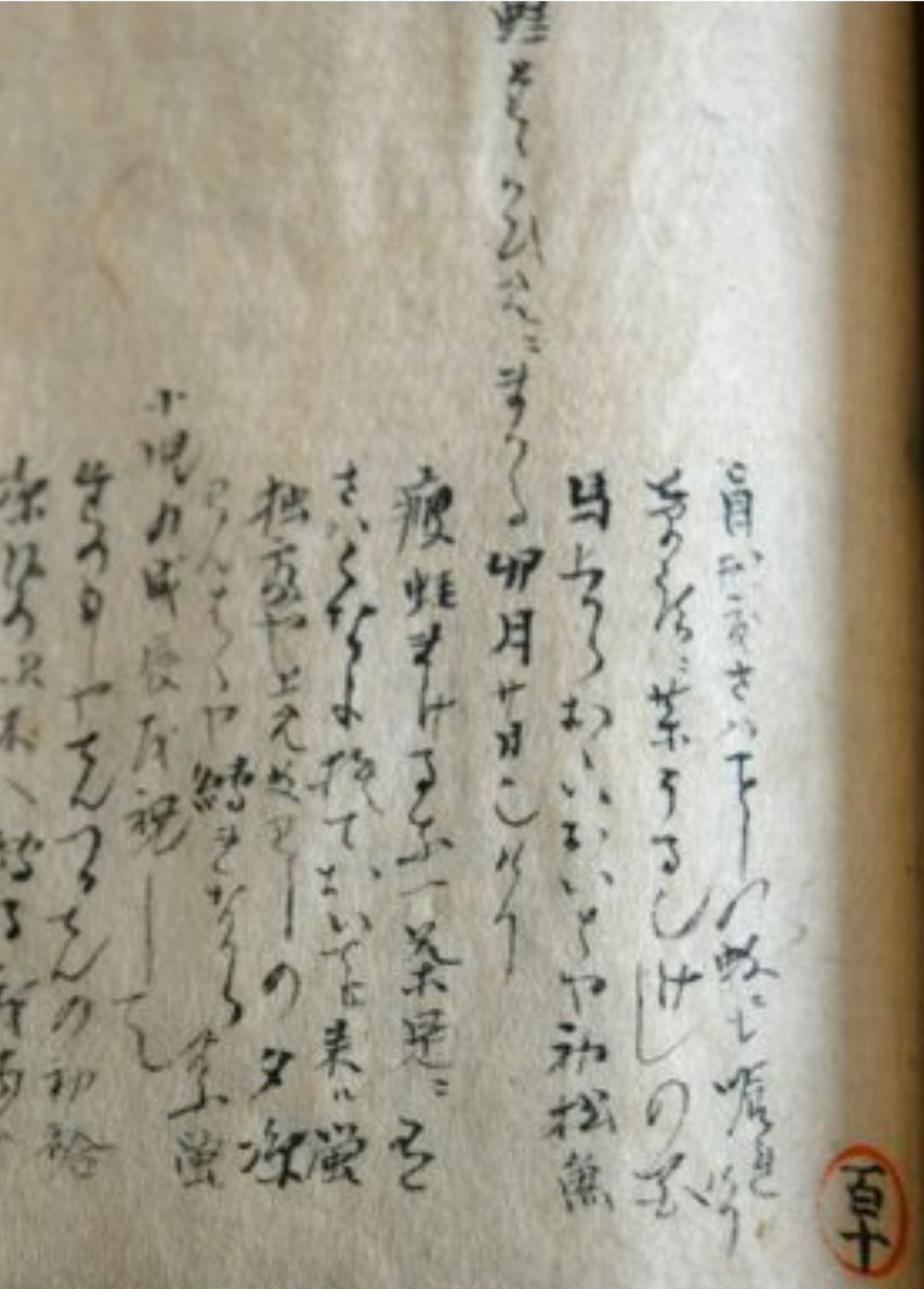
調べてみると、痩蛙の句の一茶自筆本が発見されており、そこにはかなで痩がへると書かれているそうだ。だから、他の句帖で痩蛙と表記されている場合も<かへる>と読むようだ。この句の光景について計量計測データバンクの記事に次の解説があり興味深い。
Upon investigation, it appears that a handwritten copy of Issa’s haiku featuring the “skinny frog” has been discovered, and it is said to be written in kana as “yasegaeru.” Therefore, even when it is written as “yasegaeru” in other haiku collections, it seems to be read as “kaeru.” There is an interesting explanation regarding the scene depicted in this haiku in an article from the Quantitative Measurement Data Bank.
…岩松院のヒキガエルは4月20日ごろに裏山から池に300匹ほどが大挙して産卵のために降りてきて、ここでオスガエルたちがメスをめぐってカエル合戦をするのである。岩松院の池に集まってくるカエルはヒキガエルである。岩松院の説明ではこれはアズマヒキガエルであるという…ヒキガエルは合戦がすむと山に帰っていき、池には卵が残される。
…Around April 20, about 300 Japanese toads descend en masse from the hills behind Gansho-in Temple to the pond to lay their eggs, and here the male toads engage in a “frog battle” over the females. The toads that gather at Gansho-in Temple’s pond are Japanese toads. According to Gansho-in’s explanation, these are Oriental toads… Once the battles are over, the toads return to the mountains, leaving their eggs behind in the pond.
参考までに、David G. Lanoue 氏*の英語訳を見てみよう。一茶の俳句の多くを翻訳し句ごとに訳注を付している同氏サイトで検索すると<frog>の句213が表示される。これらの中で<かへる><かはづ>とかな表記されたものは除いて漢字<蛙>をみると、痩蛙の句以外は蛙をすべて<kawazu>と読んでいる。
痩蛙まけるな一茶是に有り
yasegaeru makeru na issa kore ni ari
scrawny frog, hang tough! Issa is here
Composed at Ganshoin Temple in Obuse, Nagano Prefecture in 1816. In his diary, Issa explains, “I stooped to watch a frog scuffle on the 20th day of Fourth Month.” Since he likes to describe himself as impoverished and hungry, Issa feels a special kinship with the scrawny frog battling for a mate. (1816年長野県小布施の岩松院にて作句。日記には「4月20日屈み込んで蛙の喧嘩を見た」と述べている。自身を好んで飢えた貧者と表現する一茶は、交尾相手を求めて争う痩せ細った蛙に格別な親近感を抱いたのである。)
*He describes himself as a translator of Japanese haiku, a teacher of English and world literature, a writer of haiku and haiku novels.
Lanoue 氏が a frog scuffle (蛙の喧嘩)としているのは「蛙たゝかひ」だと考えられる。Stooped としたのは同氏による情景描写だろうが、作者が屈み込んで観察しているようすが伝わってくる。
It is believed that what Mr. Lanoue refers to as a “frog scuffle” is actually “kaeru tatakai” (frog fight). His use of the term “stooped” is likely his own description of the scene, but it conveys the sense that the artist is crouching down to observe the action.
| 蛙たゝかひ見にまかる四月廿日也けり 2741 痩蛙まけるな一茶是に有 七番日記 化13 (出典とその前書きは次のとおり) |
| 『浅黄空』前書き「たゝかひを見て」 |
| 『希杖本』前書き「むさしの国竹の塚といふに蛙たゝかひありけるに見にまかる四月廿日也けり」 |
| 真蹟 前書き「蛙たゝかひを見にまかる四月廿日也けり」「蛙たゝかひ」 |
| 『句稿消息』『自筆本』 |


Leave a Reply